
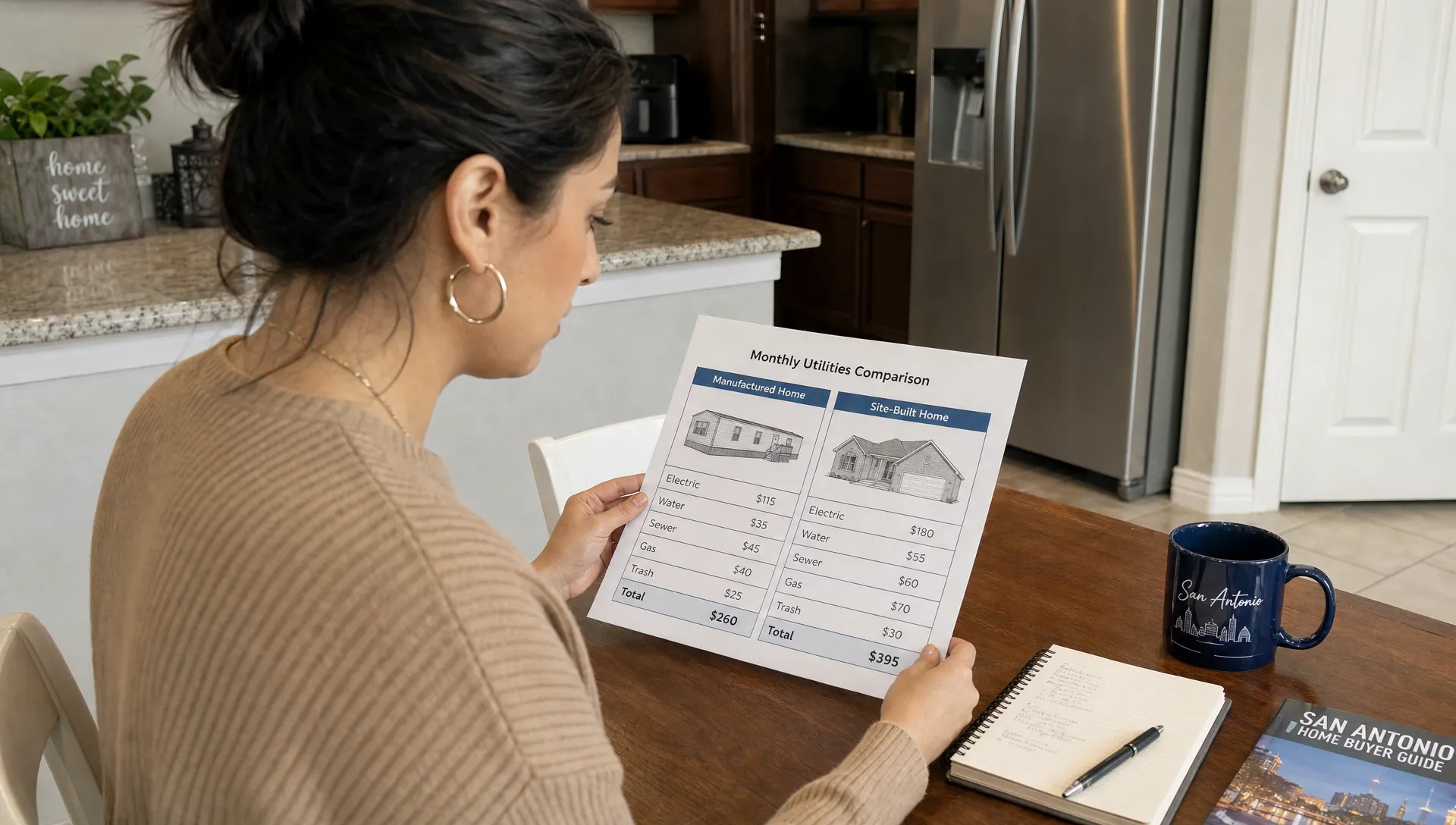
For San Antonio buyers, the cost of owning a home does not stop at the monthly payment. Electricity, water, sewer, trash and heating fuel can change the real affordability of a home, especially in a hot climate where air conditioning works hard for much of the year.
A useful utility bills comparison between manufactured and site-built homes should not ask, "Which type is always cheaper?" The better question is, "Which specific home is more efficient for the way my household lives?" A newer manufactured home with a right-sized floor plan may cost less to cool than a larger older site-built house. A high-performance new site-built home may compete closely with a manufactured home if it has strong insulation, efficient windows and a properly sized HVAC system.
This guide breaks down the main bill categories, the construction details that affect them and the questions San Antonio buyers should ask before choosing between a manufactured home and a traditional site-built home.
What should be included in a utility bills comparison?
Most buyers think first about electricity, and in South Texas that makes sense. Cooling is often the biggest seasonal driver of household utility costs. But a fair comparison should include every recurring service connected to the home.
For most manufactured and site-built homes, compare these monthly costs:
- Electricity for cooling, lighting, appliances, outlets and possibly heating
- Natural gas or propane, if the home uses gas heat, a gas range or a gas water heater
- Water and sewer charges
- Trash collection and recycling
- Internet and cable, if needed
- Community utility fees, if the manufactured home is in a land-lease community
- Fixed service charges that appear even when usage is low
Those fixed charges matter. Two homes can use similar electricity, but one bill may be higher because of utility provider fees, sewer minimums or community billing rules. If you are comparing a manufactured home in a community against a site-built home on private land, make sure you are comparing the full monthly housing picture, not just the electric bill.
If you are evaluating a community or rented lot, Homes2Go has a helpful guide on utilities to confirm before renting a mobile home lot that covers questions about electricity, water, sewer, gas, trash and drainage.
Why manufactured and site-built homes can have different utility costs
Manufactured homes and site-built homes are built through different processes, and that can affect energy performance.
Modern manufactured homes are built in a controlled factory setting and must meet the federal HUD Code for manufactured housing. The U.S. Department of Housing and Urban Development explains that the HUD Code covers design and construction, strength and durability, transportability, fire resistance, energy efficiency and quality standards for manufactured homes. You can review HUD's overview of manufactured housing standards for more context.
Site-built homes are constructed on the property and must comply with applicable state and local building codes. Their energy performance can vary widely depending on age, builder quality, renovations, insulation, window quality and whether previous owners maintained the HVAC system.
That wide variation is why broad assumptions can mislead buyers. A 2026 manufactured home should not be compared to a 1970s site-built home as if construction type is the only difference. Age, size and systems matter just as much.
| Factor | Manufactured home considerations | Site-built home considerations | What buyers should compare |
|---|---|---|---|
| Square footage | Often available in efficient, right-sized layouts | Can range from compact to very large | Total conditioned space and ceiling height |
| Construction age | Newer homes may include updated efficiency features | Older homes may have air leaks or aging insulation | Year built and any energy upgrades |
| HVAC system | Factory-planned layouts can help with equipment planning | Quality depends on builder and later replacements | System age, size and service history |
| Windows | Many newer models offer modern window packages | Older windows may allow more heat gain | Window type, shading and condition |
| Air sealing | Factory construction can support consistent assembly | Depends on jobsite quality and repairs | Drafts, duct leaks and attic penetrations |
| Billing setup | Community billing may affect water, sewer or trash charges | Usually billed directly by municipal or utility providers | Included services, separate meters and fees |
Electricity and cooling: the biggest San Antonio variable
In San Antonio, electricity is usually the first line item to examine. Air conditioning can dominate summer bills, so cooling efficiency often determines whether one home is easier to afford month after month.
The U.S. Department of Energy's Energy Saver program recommends air sealing, proper insulation, efficient windows and well-maintained heating and cooling equipment as core ways to reduce energy waste. Those principles apply to both manufactured and site-built homes.
For manufactured homes, utility performance often benefits from practical design choices. A floor plan with less wasted space, a properly sized HVAC system and modern insulation can reduce the amount of air that must be cooled. Homes2Go covers this topic in more detail in its guide to how manufactured homes can lower utility bills.
For site-built homes, the range is wider. A newer home built to recent energy codes may perform well, especially if it has efficient windows, attic insulation and shaded exposures. An older home with leaky ducts, single-pane windows or poor attic insulation may use far more electricity to maintain the same indoor temperature.
The key is to compare details, not labels. Ask for the HVAC age, filter size, service history, insulation information and window type. If the home is pre-owned, request past utility bills if available. If it is new, ask the seller to explain the energy-related features included in that specific home.
Square footage can make or break the comparison
A smaller, efficient home often costs less to run than a larger home with similar construction quality. That sounds obvious, but many buyers compare a manufactured home and a site-built home only by bedroom count or monthly payment. Utility bills are tied to the volume of space you heat, cool and light.
A fair comparison should put square footage near the top of the worksheet. For example, the Legacy Heritage H-3264-32A is a 3 bedroom, 2 bathroom doublewide manufactured home with 1,865 square feet and dimensions of 32' x 64'. A buyer comparing it with a similarly sized site-built home should look at the HVAC system, insulation, window package and layout efficiency, not just the fact that one is manufactured and one is site-built.
The same logic applies to larger households. The Oak Creek Hope is a 4 bedroom doublewide manufactured home with 2,077 square feet and 2 to 3 bathrooms, depending on configuration. A family comparing that plan against a 4 bedroom site-built home should account for total conditioned square footage, room layout and how the home will be used throughout the day.
A home with unused rooms, tall ceilings or long hallways may require more cooling than a more efficient layout with the same bedroom count. For utility bills, livable design matters.
Water, sewer and trash bills: smaller, but still worth comparing
Electricity gets the most attention, but water and sewer bills can surprise buyers. In many areas, sewer charges are tied to water usage or calculated using a seasonal average. Irrigation, landscaping and household size can all affect the bill.
Manufactured homes and site-built homes use water in similar ways inside the home. Toilets, showers, faucets, dishwashers and washing machines drive most indoor usage. The bigger difference often comes from the property setup.
A site-built home on a larger lot may have more landscaping to water. A manufactured home in a community may have different rules for lawn care, irrigation or common-area costs. In some communities, water, sewer or trash may be billed through the community rather than directly by a municipal provider. That is not automatically good or bad, but buyers should understand it before estimating monthly costs.
Ask these questions before you compare water and sewer costs:
- Is the home separately metered for water?
- Are sewer charges billed separately or bundled with water?
- Is trash collection included in community fees or billed separately?
- Are there minimum monthly charges even when usage is low?
- Does the lot require regular watering or special drainage maintenance?
For buyers comparing the full cost of a home and land package, it can also help to review how different ownership setups affect monthly expenses. Homes2Go's guide on comparing mobile homes for sale and land by total costs explains the difference between upfront, monthly and long-term expenses.
Heating fuel: less dominant in San Antonio, but not irrelevant
San Antonio winters are mild compared with northern climates, but heating still matters. Some homes use electric heat pumps, some use electric resistance heat and others use natural gas or propane. The fuel type can change both the utility provider and the bill pattern.
A heat pump can be efficient in mild winter weather when properly sized and maintained. Electric resistance heating can use more electricity during cold snaps. Gas heat may reduce electric usage, but it adds a separate gas bill with its own fixed charges.
When comparing a manufactured home and a site-built home, ask what system provides heat and hot water. A home with gas heat and a gas water heater may show lower electric bills than an all-electric home, but the gas bill must be added back into the monthly comparison.
The role of windows, insulation and air sealing
Windows, insulation and air sealing control how hard the HVAC system has to work. In summer, the goal is to keep outdoor heat out and cooled air in. In winter, the goal is the reverse.
ENERGY STAR notes that certified windows, doors and skylights can help lower household energy bills when selected and installed properly. In South Texas, buyers should pay close attention to solar heat gain, window orientation and shading. A west-facing wall with large unshaded windows can increase late-afternoon cooling demand, no matter how the home was built.
Insulation also needs context. Attic insulation, wall insulation, floor insulation and duct insulation each play a different role. In site-built homes, attic insulation is often visible and upgradable. In manufactured homes, ask the seller or retailer what insulation package applies to the specific model.
Air sealing is less visible but just as important. Gaps around ducts, plumbing penetrations, doors, vents and attic access points can waste conditioned air. A home that feels drafty may cost more to cool and heat, even if the HVAC equipment looks powerful.
Maintenance can erase the savings of a good design
A well-designed home can still produce high bills if the HVAC system is neglected. Dirty filters, clogged coils, leaking ducts and poor thermostat habits all push utility costs higher. This is true for both manufactured and site-built homes.
Before buying, ask about maintenance records if the home is not new. If the HVAC system is older, consider having it evaluated by a qualified professional. A system that is too large may short-cycle and fail to remove humidity well. A system that is too small may run constantly and still struggle to cool the home.
For a move-in ready manufactured home, buyers should still ask how to care for the system after purchase. Filter replacement, thermostat settings, skirting condition and vent clearance all affect long-term performance.
A practical worksheet for comparing utility bills
The best utility bills comparison is specific. Use the same categories for each home and gather as much documentation as possible. If one home is new and the other is pre-owned, you may not get identical information, but you can still compare the main drivers.
| Comparison item | Why it matters | What to request or inspect |
|---|---|---|
| Monthly electric history | Shows actual usage patterns for a pre-owned home | 12 months of bills, if available |
| HVAC age and type | Cooling and heating drive major energy costs | Equipment label, service records and system type |
| Home size | Larger conditioned space usually costs more to run | Square footage and ceiling height |
| Window condition | Heat gain affects summer bills | Window type, shading and seal condition |
| Insulation information | Helps predict heating and cooling demand | Model specs or inspection notes |
| Water and sewer billing | Charges may be direct, bundled or community-billed | Utility provider details and fee schedule |
| Trash and community fees | May be included or separate | Written list of included services |
| Appliance efficiency | Older appliances can add usage | Appliance labels, age and fuel type |
If you can access past bills, compare usage, not only dollars. Electricity rates and billing structures can change, so kilowatt-hours tell you more about the home and household behavior. For water, gallons used can help separate household habits from pricing.
If past bills are not available, compare the physical features that drive usage: size, HVAC, insulation, windows, appliances and billing setup.
So, which home type usually has lower utility bills?
There is no honest one-word answer. A modern manufactured home can be very competitive on utilities, especially when it has an efficient layout, updated construction features and the right amount of space for the household. A large or older site-built home may cost more to cool because it has more conditioned space, outdated windows or air leaks.
At the same time, a new site-built home with high-performance construction can also deliver strong utility performance. The better buy depends on the specific home, the land or community setup, local utility rates and how your household uses energy and water.
For many San Antonio buyers, manufactured homes are attractive because they combine attainable pricing with practical floor plans and modern features. When utility bills are part of the decision, the smartest move is to compare total monthly cost instead of focusing only on purchase price.
Frequently Asked Questions
Are manufactured homes cheaper to cool than site-built homes? They can be, especially when the manufactured home is newer, right-sized and built with efficient cooling features. A large or older site-built home may cost more to cool, but a high-performance new site-built home may be similar or lower. Compare square footage, HVAC details, insulation and window quality.
Do manufactured homes use more electricity? Not automatically. Electricity use depends on home size, HVAC efficiency, insulation, appliances, air sealing, thermostat habits and local weather. A modern manufactured home with an efficient layout may use less electricity than a larger older site-built home.
What utility bills should I ask about before buying a manufactured home? Ask about electricity, water, sewer, trash, gas or propane, internet availability and any community-billed utility fees. Also confirm whether services are separately metered and whether any minimum monthly charges apply.
How can I compare two homes if one is larger? Look at total monthly utility cost, but also compare usage relative to square footage. A larger home may have higher total bills even if it is efficient. If your household does not need the extra space, a smaller floor plan may be more affordable to operate.
Should I rely on past utility bills from the seller? Past bills are useful, but they reflect the previous household's habits. Use them as one data point alongside HVAC age, insulation, windows, appliances and your own expected usage.
Compare homes with monthly costs in mind
If you are shopping for a manufactured home in San Antonio, utility costs deserve a place beside floor plan, location and financing. Homes2Go San Antonio offers a wide selection of manufactured homes, detailed floor plans, guidance for first-time buyers and access to trusted local lenders.
Explore available options through Homes2Go San Antonio and compare each home by the way it will actually live month to month: space, comfort, utility setup and total affordability.
 How to Compare Modular Home Communities Near You
 Buying Land for a Manufactured Home: Step-by-Step