
Yes, some buyers can purchase no money down mobile homes in Texas, but zero-down financing is not available for every buyer, home or location. The clearest possibilities are eligible USDA and VA loans. Down payment assistance or equity in land you already own may also reduce the cash you need upfront, subject to lender and program rules.
The distinction that matters most: no down payment does not necessarily mean no cash due before move-in. Closing costs, deposits and site expenses can remain your responsibility. Before choosing a home, confirm which financing route fits both your qualifications and where you plan to put it.
What does “no money down” actually mean?
A down payment is the portion of the purchase price you contribute rather than finance through the primary loan. A true zero-down program does not require that contribution from an eligible borrower.
Other arrangements can produce a similar cash outcome without being zero-down loans. For example, an assistance program might cover a required down payment, or a lender might accept qualifying land equity toward your contribution.
These distinctions affect what you owe later. Assistance may be a grant, a forgivable second loan or a repayable loan. Land equity is value you already own, not free money supplied by the lender.
Before responding to an advertisement, ask whether “zero down” means no required down payment, no buyer-funded down payment or genuinely no cash to close. Those are different promises.
Which financing options support no money down mobile homes?
The right route depends on your eligibility, the property and how the transaction is structured. A loan covering a manufactured home and land is different from a loan covering only the home.
| Financing route | How upfront cash may be reduced | Main condition to verify |
|---|---|---|
| USDA guaranteed loan | Eligible purchases can receive 100% financing | Household income, property location and manufactured-home eligibility |
| VA purchase loan | Eligible borrowers may buy without a down payment | VA eligibility, entitlement, appraisal and lender acceptance of the home |
| Down payment assistance | Approved funds may cover some required upfront costs | Program compatibility with the home and primary mortgage |
| Land equity | Acceptable equity may count toward the required contribution | Land value, existing liens and lender rules |
| Financiamiento solo de casa | Terms vary; zero down should not be assumed | Required down payment and acceptable sources of funds |
USDA loans: check the address and the home
el Programa de Préstamo Garantizado de Vivienda Unifamiliar de USDA offers 100% financing to eligible borrowers purchasing qualifying primary residences in eligible rural areas.
“Rural” is a program designation, not simply a description of how remote a property looks. Check the exact address rather than assuming a property outside San Antonio qualifies.
USDA also evaluates household income and repayment ability. The manufactured home must satisfy applicable requirements, and the lender must offer financing for that type of property. Requirements can differ for new and existing manufactured homes, so have the lender review the specific unit before making a nonrefundable commitment.
For buyers researching no money down mobile homes, USDA can be a useful starting point when the plan includes an eligible land-home purchase. A qualifying address alone, however, does not establish loan approval.
VA loans: an option for eligible military buyers
Eligible veterans, service members and certain surviving spouses may qualify for a VA-backed purchase loan. VA loans can finance eligible manufactured homes, but not every VA lender handles them.
For borrowers with full entitlement, VA generally does not require a down payment when the purchase price is no higher than the appraised value. A lender may still require one in some circumstances, and an appraisal shortfall can create an additional cash requirement.
Ask about manufactured-home eligibility before paying application-related expenses. The lender needs to evaluate the home, its foundation, the land arrangement and how ownership will be documented.
A VA funding fee may apply unless you qualify for an exemption. Financing an eligible fee can reduce cash due at closing, but it increases the amount borrowed. VA eligibility also does not eliminate credit, income or property approval requirements.
Down payment assistance: check the repayment terms
An assistance program may help cover a down payment, closing costs or both. Availability depends on the program, funding, participating lender and property type. Some programs restrict the manufactured homes they will accept or require a particular mortgage structure.
Our overview of Texas affordable housing programs for home buyers explains the broader assistance landscape. For a specific purchase, ask a participating lender to confirm eligibility for the actual manufactured home, not just eligibility for assistance in general.
Assistance can make no money down mobile homes possible from the buyer’s cash perspective, but the underlying mortgage may still require a down payment. FHA financing, for example, can allow 3.5% down for qualifying borrowers; it is not inherently a zero-down loan.
Get written answers about whether assistance must be repaid, whether interest accrues and what happens if you sell or refinance. “Forgivable” does not necessarily mean forgiven immediately.
Land equity: value you own may replace cash
If you already own land, a lender may accept qualifying equity toward the contribution required for a land-home transaction.
Suppose an acceptable appraisal values your land at $45,000 and it has a $15,000 outstanding lien. That suggests $30,000 in equity before the lender applies its valuation and underwriting rules. It does not guarantee a $30,000 credit toward your purchase.
The lender must review ownership, liens, the proposed improvements and the completed property’s value. Land equity also does not pay contractors directly unless an approved financing arrangement funds those expenses.
This route can reduce cash needed upfront, but it puts the land into the financing arrangement. Ask what property secures the loan and what could be at risk if payments are not made.
What if the home will sit on a rented lot?
A home in a manufactured-home community may be financed separately from the land through a home-only loan, often called a chattel loan. That structure changes the available financing options.
Do not assume a zero-down land-home mortgage can be used for a home placed on a rented lot. Some programs have specific leasehold provisions, but availability depends on both program requirements and lender participation.
When comparing no money down mobile homes in communities, ask whether the offer applies to home-only financing or requires you to own the land. Also confirm whether the community must approve you separately.
Your housing budget should include the home payment, lot rent, insurance, utilities and applicable taxes or fees. Even if the loan requires no down payment, community deposits and move-in charges may still require cash. A low advertised home payment is not the same as a complete monthly housing cost.
Zero down is not zero cash to close
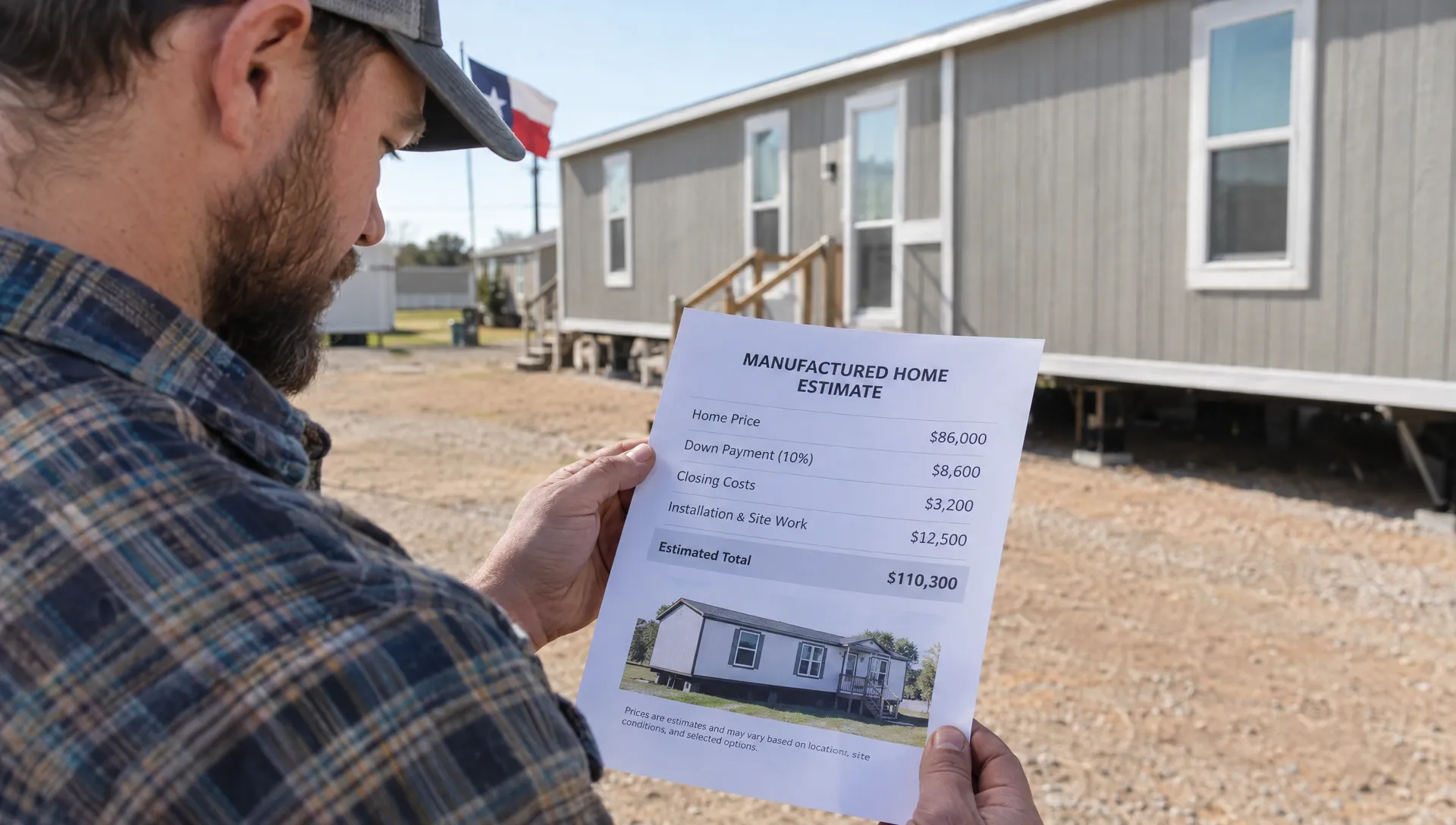
The most useful number to request is estimated total cash needed through move-in, not just the down payment.
Depending on the transaction, you may need money for an earnest-money deposit, appraisal, inspections, closing charges, insurance and prepaid taxes. A land-home project can also involve delivery, installation, foundation work, permits and utility connections. Some expenses may be financed; others may fall outside the loan or become due before closing.
For example, a hypothetical $180,000 purchase with a 3.5% down payment requires $6,300 down. A true zero-down program removes that particular requirement. It does not automatically eliminate other expenses. If $6,000 in closing costs and prepaids remains uncovered, you still need that money unless an approved source pays it.
When evaluating no money down mobile homes, ask the lender to separate the down payment from all other buyer-paid costs. Then ask the retailer or installer which expenses are included in the home contract and which are not.
Seller or lender credits may help with allowable closing costs, subject to program limits. They are not unrestricted cash, and a lender credit can involve a higher interest rate. Compare the long-term cost as well as the upfront savings.
How to verify an offer before committing
Have the lender review the actual property
A general prequalification does not establish that a particular manufactured home is financeable. Give the lender the property address, home details, expected purchase price and proposed land arrangement.
For used homes, disclose the year built and any known relocation history. Older units, previously moved homes or missing documentation can create financing obstacles. The lender may also require evidence of HUD-code compliance, an acceptable foundation and appropriate ownership classification.
Ask whether the preliminary assessment covers both the borrower and the proposed home. Finding a property restriction after paying deposits can disrupt an otherwise workable purchase.
Request a complete written financing breakdown
A quote for no money down mobile homes should identify the loan program, purchase price, loan amount, required contribution, assistance and estimated cash to close. It should also explain which expenses must be paid earlier.
For a mortgage subject to Loan Estimate requirements, use the Consumer Financial Protection Bureau’s Loan Estimate guide to understand the disclosures and compare offers. Home-only financing can use different disclosures, so ask the lender which documents apply.
Compare interest rate, APR, loan term and total monthly obligations. A longer term can lower the payment while increasing total interest. Verify whether an advertised payment excludes lot rent, taxes or insurance.
Confirm funding sources and deposit conditions
If the purchase depends on assistance, a gift or land equity, have the lender approve that source before relying on it. Do not take out a separate personal loan for upfront costs without discussing it with the mortgage lender. New debt can affect qualification, and borrowed funds are not acceptable for every purpose.
Before paying a deposit, get the refund conditions in writing. Ask what happens if financing is denied, the site fails approval or the home does not satisfy program requirements.
Keep copies of the advertisement, price quote and financing disclosures. Any difference between the advertised offer and your actual terms should be explained before you sign.
Preguntas frecuentes
Can I qualify with bad credit and no down payment? Possibly, but zero-down eligibility does not waive credit review. Lenders evaluate credit history, income, debts and the property. No legitimate lender can promise approval for every credit profile.
Can I buy a used mobile home with nothing down? Sometimes, if both the home and borrower satisfy an available program’s rules. Age, condition, installation, relocation history and ownership documentation can affect eligibility. Have the lender review the specific home first.
Does owning land automatically qualify me? No. The lender must accept the land, establish its value, review liens and approve the overall transaction. You must also qualify as a borrower.
Are there grants that cover every upfront expense? Do not assume so. Assistance has limits and eligibility conditions, and some offers are loans rather than grants. Request a written estimate showing any costs left for you to pay.
Discuss your Texas home and financing options
The practical way to shop for no money down mobile homes is to identify an eligible financing path before committing to a model or site.
Homes2Go San Antonio offers a selection of manufactured homes, flexible financing options and guidance for first-time buyers. Contact the team with your budget, preferred location and whether you own land or plan to rent a lot. Ask which available homes and lender options fit your circumstances, then obtain written financing terms. Zero-down availability depends on borrower, property, lender and program approval.
 Can You Get an FHA Loan for Used Mobile Home?