
Estimating manufactured home value is harder than most people expect, not because the math is complicated, but because the details matter. A 2019 double-wide on a permanent foundation on owned land can be valued like real estate. A similar home in a land-lease community may be valued more like personal property, even if it is beautifully maintained.
If you are buying, selling, refinancing, or insuring a manufactured home in the San Antonio area, the goal is the same: get an estimate that reflects what the home would realistically sell for in its current setup.
Start with the right definition of “value”
Before you compare numbers, clarify what kind of value you need, because different “values” can be legitimate and still disagree.
- Market value: what a typical buyer would pay in the current market (most useful for selling and buying).
- Appraised value: a professional opinion of market value used by lenders (often required for mortgages).
- Assessed value: the value used for property tax purposes (can be higher or lower than market value).
- Replacement cost: what it would cost to replace the home (common for insurance), which can differ significantly from resale value.
When people say “manufactured home value” online, they often mix these up. For an accurate estimate, pick one target first, usually market value.
Step 1: Identify the home precisely (model, year, and HUD documentation)
Accurate valuation starts with accurate identification. Manufactured homes are frequently mis-listed by year, size, or build standard, and small errors can skew comps and guidebook ranges.
Here is what to gather:
- Year built and manufacturer
- Dimensions and layout (single-section vs multi-section, total square footage)
- Bedrooms/bathrooms and any major layout changes
- HUD labels and data plate information (for homes built to the HUD Code, generally after June 15, 1976)
If you are not sure where to find HUD-related info, HUD provides an overview of manufactured housing standards and labeling on its manufactured housing page: HUD manufactured housing.
Step 2: Separate “home value” from “land value” (and know how the home is titled)
One of the biggest reasons manufactured home estimates go wrong is failing to separate what you are actually valuing.
Is the home on owned land or in a land-lease community?
- Owned land: your total market value is typically “land + home + site improvements.”
- Land-lease community: your market value is often primarily the home itself (plus any attached improvements), and buyers also evaluate the monthly lot rent and park rules.
Is it treated as real property or personal property?
In Texas, manufactured homes can be titled and recorded in ways that affect financing options, appraisal approach, taxes, and buyer demand. Title and ownership records are handled through the Texas Department of Housing and Community Affairs (TDHCA). See: TDHCA Manufactured Housing Division.
Practical impact: if you are comparing your home to a sale that included land and yours does not, that is not a like-for-like comp.
Step 3: Use the valuation method that matches your situation
There are three common valuation approaches. Most homeowners benefit from understanding all three, even if only one is used for the final number.
Sales comparison approach (best for most resale estimates)
This method looks at recent sales of similar homes and adjusts for differences (size, condition, land, upgrades, location). For most buy/sell decisions, this is the most realistic framework.
Cost approach (useful for newer homes and insurance conversations)
This starts with what it would cost to replace the home today, then subtracts depreciation, then adds the contributory value of site improvements. It can be helpful when comps are thin, but it can also overestimate resale value in areas where buyers will not pay replacement-cost pricing.
Income approach (only if the home is an investment rental)
If the home is producing rental income, investors may value it based on income, expenses, and market cap rates. This is less common for owner-occupied purchases but relevant for some buyers.
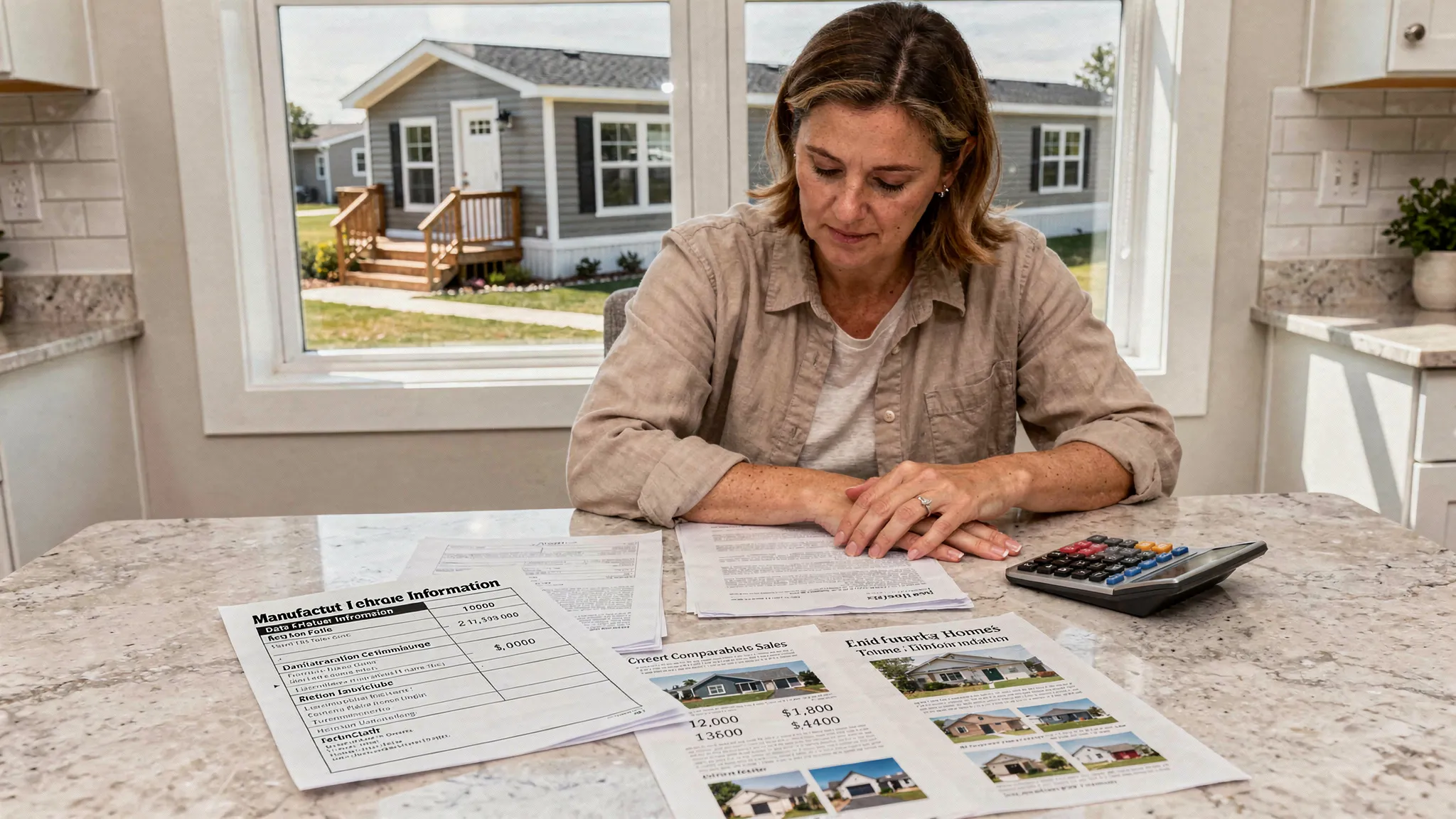
Step 4: Build a comp set that is actually comparable
The most reliable DIY estimate comes from solid comparable sales, not asking prices. (Listings can be useful, but they are not proof of value.)
When you pull comps, try to match:
- Home type: manufactured vs modular vs site-built (do not mix these)
- Construction era: similar decade, similar condition
- Section count: single-section vs double-wide vs triple-wide
- Placement: owned land vs land-lease community
- Location: same side of San Antonio when possible, similar schools and commute patterns
If you are in a community, the most comparable sales are often within the same community (or similar communities with similar lot rent and rules).
Step 5: Make clean adjustments for the factors that move value most
Once you have a few comps, the question becomes: “How different is my home from those?” In manufactured housing, a handful of categories tend to drive most price differences.
High-impact value drivers (what appraisers and buyers notice first)
| Factor | Why it moves manufactured home value | What to document |
|---|---|---|
| Land vs land-lease | Changes what is included in the sale and how buyers underwrite monthly costs | Deed/land info, lot rent, community rules |
| Title status and property classification | Affects financing availability and buyer pool | Title/statement of ownership, lien releases |
| Condition | Condition drives buyer confidence and lender acceptance | Roof age, HVAC age, flooring, subfloor condition |
| Foundation and installation quality | Permanent foundation and proper installation can expand financing options | Installer docs, engineering letter (if applicable) |
| Size and layout | Two homes with the same square footage can value differently based on layout | Floor plan, room dimensions |
| Upgrades that reduce operating costs | Energy and durability improvements can increase buyer willingness to pay | Receipts, specs, warranty info |
A note on energy-efficiency upgrades
In Texas heat, operating cost matters. Features like better insulation, high-performance windows, tight ductwork, and right-sized HVAC can influence buyer demand, especially when utilities are a pain point.
If you are trying to understand which improvements tend to matter most for comfort and bills, see: energy-efficient manufactured homes in Texas heat.
Step 6: Add site improvements carefully (cost is not the same as value)
Decks, porches, carports, sheds, driveways, skirting, fencing, and utility upgrades can all affect marketability, but they rarely add dollar-for-dollar resale value.
A practical way to think about it is contributory value, meaning “how much more would a typical buyer pay because this improvement exists?”
To estimate contributory value more accurately:
- Compare your home to a comp without the improvement.
- Look for patterns across multiple comps (not just one listing).
- Prioritize improvements that buyers perceive as reducing risk (for example, good drainage, solid skirting, a well-maintained roof structure, documented HVAC service).
Step 7: San Antonio area specifics that can change the number
Manufactured home values are local. In and around San Antonio, a few location and placement details commonly swing buyer demand.
- Flood risk and drainage: buyers may discount homes with known water issues. You can check flood maps using FEMA Flood Maps.
- Commute patterns and access: proximity to major routes and job centers can matter, even for land-lease communities.
- Community rules and lot rent: in land-lease parks, a “great home” can still be harder to sell if lot rent is high relative to the local market or rules restrict buyers.
If you are comparing community living versus private land placement, this guide provides helpful context on the land and home side (without relying on park-only assumptions): land and home packages in San Antonio.
Step 8: Cross-check your estimate with professional sources (without blindly trusting them)
A strong approach is to combine your comp-based estimate with at least one third-party reference point.
Common sources for manufactured home valuation
| Source | Best for | Limitations |
|---|---|---|
| Local comparable sales | True market reality | Hard to find good matches, especially for older homes |
| Lender appraisal | Refinance and purchase loans | Depends on lender requirements and available comps |
| JD Power manufactured housing pricing guides (formerly NADA) | Baseline estimate for home-only scenarios | Still needs location, condition, and setup context |
| County appraisal district data | Tax assessment context | Assessed value is not always market value |
If you are using a guidebook-style estimate (like JD Power), treat it as a starting point, then bring it back to reality with comps and the specifics of your land or community.
Step 9: Avoid these common manufactured home value mistakes
A few errors show up repeatedly in manufactured home pricing conversations:
- Comparing to site-built homes just because the square footage is similar.
- Using list prices as comps instead of closed sales.
- Ignoring land-lease terms (lot rent, fees, approval requirements) when valuing a home in a community.
- Missing the true year or model because the listing data is wrong.
- Over-crediting renovations that were expensive but not highly valued by buyers.
- Not accounting for installation realities if the home will be moved (transport, setup, permits, and site work can change buyer math fast).
For a broader overview of definitions, setup, and the local buying process, you can also reference this primer: mobile homes in San Antonio, a quick buyer guide.
A simple, accurate workflow you can use this week
If you want a practical way to estimate market value without getting lost, use this sequence:
- Collect your home’s identifiers (year, make, model, HUD data plate info, size, photos, upgrade receipts).
- Decide what you are valuing (home-only in a community, or home plus land).
- Pull 3 to 6 recent comparable sales that match your setup as closely as possible.
- Adjust comps for the big-ticket differences (land, condition, foundation/installation, size, upgrades).
- Sanity-check your range using one third-party reference (appraisal, guidebook baseline, or local professional input).
Done well, this produces a value range that is far more reliable than a single “instant estimate.”
When it makes sense to involve a retailer or lender early
If you are actively shopping or preparing to sell, you often do not need to do this alone.
Homes2Go San Antonio can help you think through what actually drives value in your situation, whether you are comparing models, evaluating communities, or planning financing routes that may affect appraisal requirements. If financing is part of your plan, start here to understand the main loan paths: manufactured home financing options.
If you want a second set of eyes on your comps, your home details, and what buyers in the San Antonio market are responding to right now, you can explore available options and guidance at Homes2Go San Antonio.
 Mobile Homes for Sale with Land: Local Insights
 Value of Mobile Homes: Appreciation, Depreciation, Trends