
Home warranty plans for mobile homes can help pay for certain appliance and system breakdowns, but they do not replace manufactured homeowners insurance. A warranty service contract generally addresses eligible failures caused by normal wear and tear. Insurance addresses covered losses such as fire, theft or wind damage and may include personal property and liability protection.
That difference matters when a repair bill arrives. An air conditioner that stops working because of a worn component presents a different coverage question from one damaged by a falling tree. The equipment may be the same, but the cause of damage determines which contract might respond.
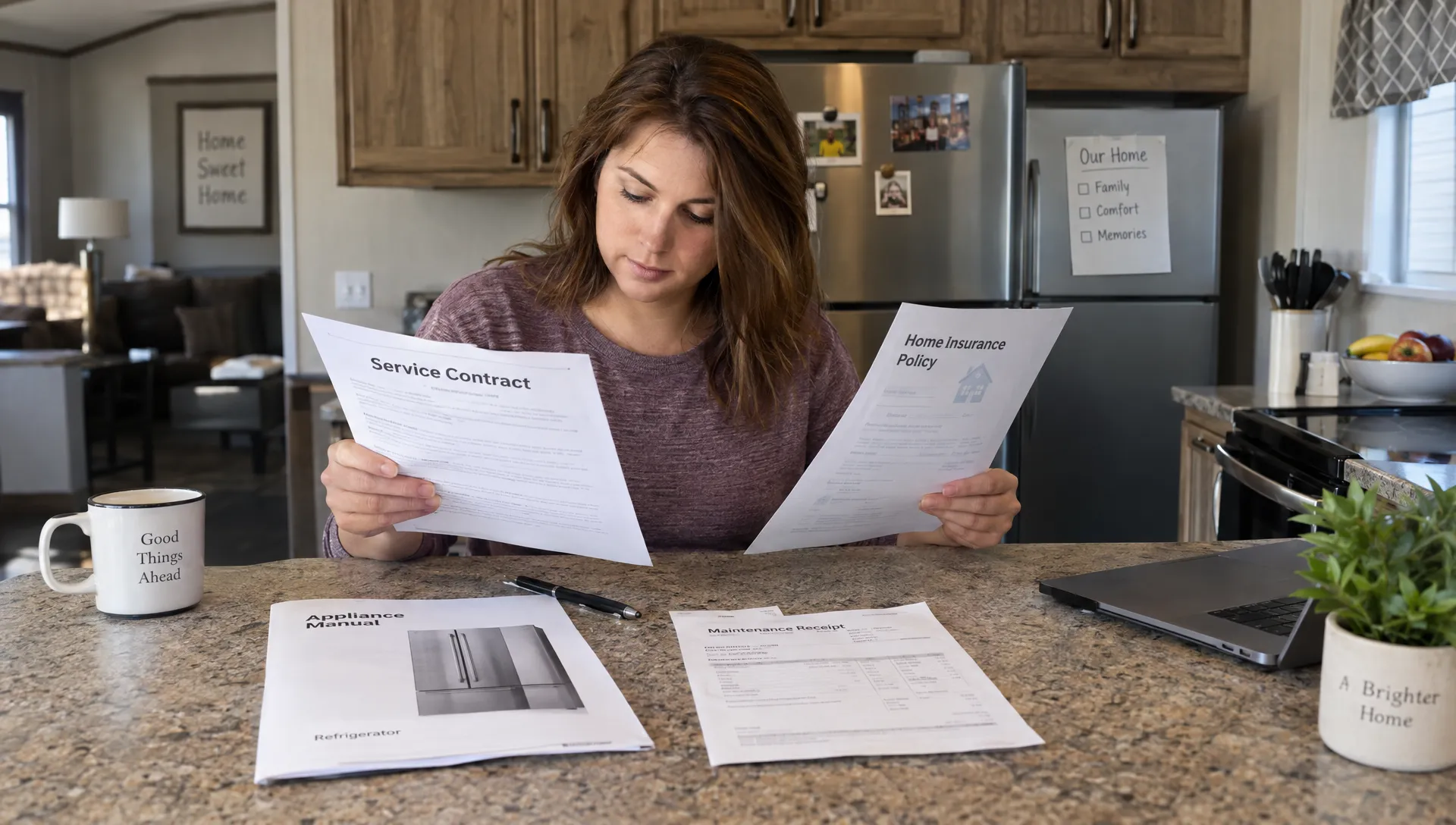
Before buying protection, separate three documents: your homeowners insurance policy, any original manufacturer warranty and any optional home service contract. Comparing them side by side helps you spot gaps without paying twice for substantially overlapping benefits.
How home warranty plans for mobile homes differ from insurance
A home warranty is a service contract, not a substitute for property insurance. Neither product covers every problem, and both can leave you responsible for deductibles, fees or excluded work.
| Coverage question | Home warranty service contract | Manufactured homeowners insurance |
|---|---|---|
| What typically triggers coverage? | An eligible appliance or system fails from covered wear and tear | A covered event causes property damage or another insured loss |
| What might it protect? | Listed equipment such as HVAC, plumbing, electrical systems and kitchen appliances | The home, covered belongings and specified liability exposures |
| What do you pay when requesting help? | A service-call fee, plus amounts excluded or above contract limits | An applicable deductible for property claims, plus uncovered amounts |
| Is ordinary equipment wear covered? | Potentially, subject to the contract | Generally not |
| Are storms or fires covered? | Usually not the purpose of the contract | Potentially, depending on covered perils and exclusions |
| Is protection mandatory? | Usually optional for the buyer | A lender commonly requires property coverage |
el Texas Department of Insurance home insurance guide explains common policy protections and exclusions. For a manufactured home, request a policy specifically appropriate for the home and its location rather than assuming a standard homeowners quote applies.
Flood damage generally requires separate flood insurance. Wind and hail coverage, exclusions and deductibles also deserve a close review, particularly when comparing Texas policies.
Can your manufactured home qualify for coverage?
Eligibility for home warranty plans for mobile homes varies by provider. A company that advertises residential coverage does not necessarily accept every manufactured home, every ZIP code or every type of placement.
Ask the provider to confirm your specific property in writing. Supply the year built, manufacturer, number of home sections, address and occupancy type. If the home was built before June 15, 1976, explicitly identify it as a pre-HUD-code mobile home rather than assuming the provider treats it like newer manufactured housing.
Foundation and installation requirements can matter, too. Ask whether the contract requires permanent installation, utility connections, particular anchoring conditions or an inspection. Equipment age may be evaluated separately from the home's age, so disclose an older HVAC system even if the rest of the home has been updated.
Does owning or renting the land make a difference?
Do not assume either arrangement automatically qualifies or disqualifies you. Establish where your responsibility ends and a community operator's responsibility begins, especially for water lines, sewer connections and shared equipment.
If you are evaluating a leased homesite, these checks for buying a mobile home without land can help clarify placement and utility responsibilities before you compare protection contracts.
Read the contract, not just the coverage checklist
When comparing home warranty plans for mobile homes, a checkmark beside “air conditioning” tells you very little about the amount the provider might actually pay. Request the full sample contract and any manufactured-home endorsement before enrolling.
Focus on these terms:
- Coverage limits: Check the annual aggregate limit, each system or appliance limit and any smaller component-specific caps.
- Service-call fees: Confirm whether you pay per visit, per trade or per service request, including when a problem is excluded.
- Waiting periods: Identify the effective date and whether failures during an initial waiting period are ineligible.
- Repair versus replacement: Determine who chooses the remedy and whether a cash settlement can replace an actual repair or replacement.
- Related expenses: Look for restrictions on access work, permits, disposal, refrigerant, code upgrades and modifications needed to install replacement equipment.
A replacement benefit may cover the equipment but not every expense necessary to make it usable. For example, adapting connections or modifying ductwork could remain your responsibility if the contract excludes those costs.
Understand exclusions and denial rules
With home warranty plans for mobile homes, exclusions can be as important as the covered-equipment list. Contracts may restrict preexisting failures, improper installation, inadequate maintenance, corrosion or particular types of components. The wording varies, including whether an unknown preexisting condition can qualify.
Ask what evidence the administrator uses to decide a claim. Maintenance receipts, inspection reports and a technician's diagnosis may become relevant. Also check whether work performed without advance authorization is excluded.
For general consumer guidance, the Federal Trade Commission explains extended warranties and service contracts, including why buyers should compare coverage with protections they already have.
Which coverage would handle these common problems?
The air conditioner stops cooling after years of use. A service contract might cover a failed listed component. Insurance generally does not pay simply because equipment wears out. A maintenance problem, excluded part or exhausted coverage limit could still leave you with the bill.
A storm damages the roof and rain enters the home. Notify your insurer promptly. Coverage depends on the policy, cause of damage, exclusions and deductible. A warranty's optional roof-leak benefit, if offered, is not equivalent to insurance for storm damage or a full roof replacement.
A pipe suddenly bursts beneath the home. Insurance may address resulting covered water damage without paying to replace a worn-out pipe. A service contract might address an eligible plumbing repair, subject to access restrictions. Gradual leaks and resulting deterioration can raise different exclusions.
The practical question is not just what broke. It is why it broke, what damage followed and which written terms apply.
Coordinate coverage with the original home warranty
Buying home warranty plans for mobile homes immediately after purchasing a new home can create overlapping benefits. Review the manufacturer's written warranty, appliance warranties and installation paperwork first. These may assign different responsibilities to the manufacturer, equipment maker, retailer or installer.
Por ejemplo, la Marathon Liberty available from Homes2Go in San Antonio is a three-bedroom, two-bathroom doublewide with 1,793 square feet. Its listed dimensions are 32' x 56', and it is Marathon Homes floor plan 32563A. When evaluating this model, request the warranty documents associated with the actual purchase rather than inferring coverage from its specifications.
A manufacturing defect, an installation problem and a later wear-related breakdown may belong to different claim processes. Ask whether a proposed service contract excludes items still covered by a manufacturer and whether overlapping coverage changes its value during the first year.
For another example of questions to ask about original coverage, this Champion warranty checklist explains why written responsibilities matter. Its brand-specific discussion should not be treated as the warranty terms for a Marathon home.
Compare total costs, not just the monthly payment
A warranty's advertised payment is only part of its cost. Compare the full annual contract price, expected service fees, optional coverage charges and expenses that remain excluded. Obtain a separate manufactured homeowners insurance quote because its premium reflects a different set of risks.
Here is an illustrative example, not a provider quote: a contract costing $600 annually, with two service requests charged at $100 each, creates $800 in plan and service-fee expenses before uncovered repairs. If the provider pays only $300 toward eligible work, the contract has not reduced that year's overall spending compared with paying those repair costs directly.
One year's outcome does not establish whether a plan will be worthwhile over time. The point is to compare realistic benefits against total costs, not to assume every approved claim produces savings.
A repair savings account is another option for breakdown expenses. It gives you control over contractors and spending, but the balance may be insufficient when a large repair happens early. Neither approach replaces insurance against covered property losses.
Confirm the provider can actually service your home
The usefulness of home warranty plans for mobile homes depends partly on local service availability. A contract accepting your address does not necessarily tell you how quickly a technician familiar with manufactured-home equipment can arrive.
Before enrolling, ask for written answers to these questions:
- Does the contract explicitly accept this home's construction type, age, foundation and occupancy?
- Are technicians available in my San Antonio-area ZIP code for my HVAC, plumbing and electrical equipment?
- Who selects the contractor, and when can I use my own licensed professional?
- How are after-hours emergencies handled, and what requires advance authorization?
- What happens if a covered repair fails again or replacement parts are unavailable?
- What are the cancellation procedure, refund calculation and any administrative fees?
Also identify the legal company responsible for the contract, not just the brand selling it. Texas buyers can use the Departamento de Texas de Licencia y Regulación to locate applicable service-contract licensing and consumer complaint resources.
Keep the actual contract version supplied at enrollment. A salesperson's explanation or a general website FAQ may not contain the exclusions that govern your claim. If an answer matters to your purchase, ask where it appears in the agreement.
What to do when something breaks
Start with safety. If there is smoke, a suspected gas leak or an electrical hazard, leave the affected area and contact emergency services or the utility as appropriate. For a water leak, shut off the supply if you can do so safely. Do not delay necessary damage mitigation while waiting for a coverage decision.
Photograph the problem and preserve receipts, maintenance records and damaged-part information where practical. Describe what happened accurately rather than trying to diagnose the cause yourself. The distinction between a failed component and resulting property damage may affect which coverage applies.
For home warranty plans for mobile homes, follow the contract's service-request process before authorizing nonemergency repairs. Confirm the service fee and obtain an authorization number. For a possible insured loss, notify your insurer promptly and follow its documentation instructions.
If coverage is denied, request the specific contract provision and supporting diagnosis in writing. Use the provider's review or complaint process if the decision appears inconsistent with your documents. A denial under one contract does not automatically establish coverage under another.
Preguntas frecuentes
Can an older mobile home get a warranty plan? Some providers accept older homes, but eligibility depends on the contract. Disclose the construction date, installation details, system condition and occupancy. Ask specifically about pre-HUD-code homes when applicable, and get acceptance in writing.
Do I need both a warranty and homeowners insurance? They serve different purposes. Insurance protects against specified losses and may be required by your lender. A service contract is generally optional. Whether it adds value depends on existing warranties, equipment condition, exclusions and your repair budget.
Are home warranty plans for mobile homes legitimate? They can be legitimate service contracts, but that does not make every offer suitable. Verify the responsible company, applicable regulatory status, local contractor availability and written terms. Be cautious about sales pitches that imply every repair is covered.
Will a home warranty replace my entire mobile home? A typical appliance-and-system service contract does not replace the whole dwelling. Insurance may address a covered total loss, subject to policy limits and settlement terms. Confirm replacement-cost provisions, depreciation rules and any requirements tied to receiving replacement benefits.
Build a coverage plan before you buy
Choose home warranty plans for mobile homes only after reviewing the protection you already have. First arrange appropriate property insurance, then identify original warranty benefits and decide whether an additional service contract fills a meaningful gap.
When comparing homes with Homes2Go San Antonio, ask for the written manufacturer and appliance warranty information associated with your selected model. Use those documents alongside an insurance quote and any proposed service contract to make a clear, informed comparison.
 How to Assess Storm Readiness at Mobile Home Parks in the Area